56.47% 01
of 241,750 appealed Medicare Advantage post-acute terminations reviewed in 2025 where QIO physicians disagreed with the plan.
When a plan moves to end a covered stay, Daybook helps your team check the notice, assemble the supporting clinical record, and track every outcome—before covered days turn into write-offs.
When a plan ends coverage, your team has little time to answer. Daybook helps put the relevant clinical evidence and notice history in order before the deadline drives the decision.
of 241,750 appealed Medicare Advantage post-acute terminations reviewed in 2025 where QIO physicians disagreed with the plan.
where termination notices clustered in Acentra’s focused study, without consistently tracking documented progress.
the operational upload window Acentra asks facilities to meet when requesting the record for expedited review.
“The burden of proof rests with the MA organization to demonstrate that termination of coverage is the correct decision.”
The plan must also supply the reviewer everything needed to sustain its decision by close of business on the day it is notified of the appeal (§422.626(e)(3)). The plan carries the burden and the plan is on a clock. Daybook’s job is to make sure your record is ready when the reviewer looks.
These are large-scale review signals, not a promise of results: 56.47% describes appealed cases in Acentra’s 29-state service area, not the unappealed population. The one-hour window is QIO operating practice, not a statutory deadline. Your review shows what is happening in your own facilities.
Dated note Prior-authorization reductions announced for October 1, 2026 do not apply to skilled nursing or home health. 06
Authorization platforms help get the stay approved and the clinicals submitted. Keep them. Daybook’s work begins the day the plan moves to end coverage anyway.
The stay is approved and clinicals go to the plan on schedule. Your existing platform handles this well.
The plan moves to end coverage. A NOMNC lands, the evidence is still scattered, and the clock starts.
Notice checked. Record assembled and cited. Deadline visible. Payment appeal run. Outcome logged by plan and reason.
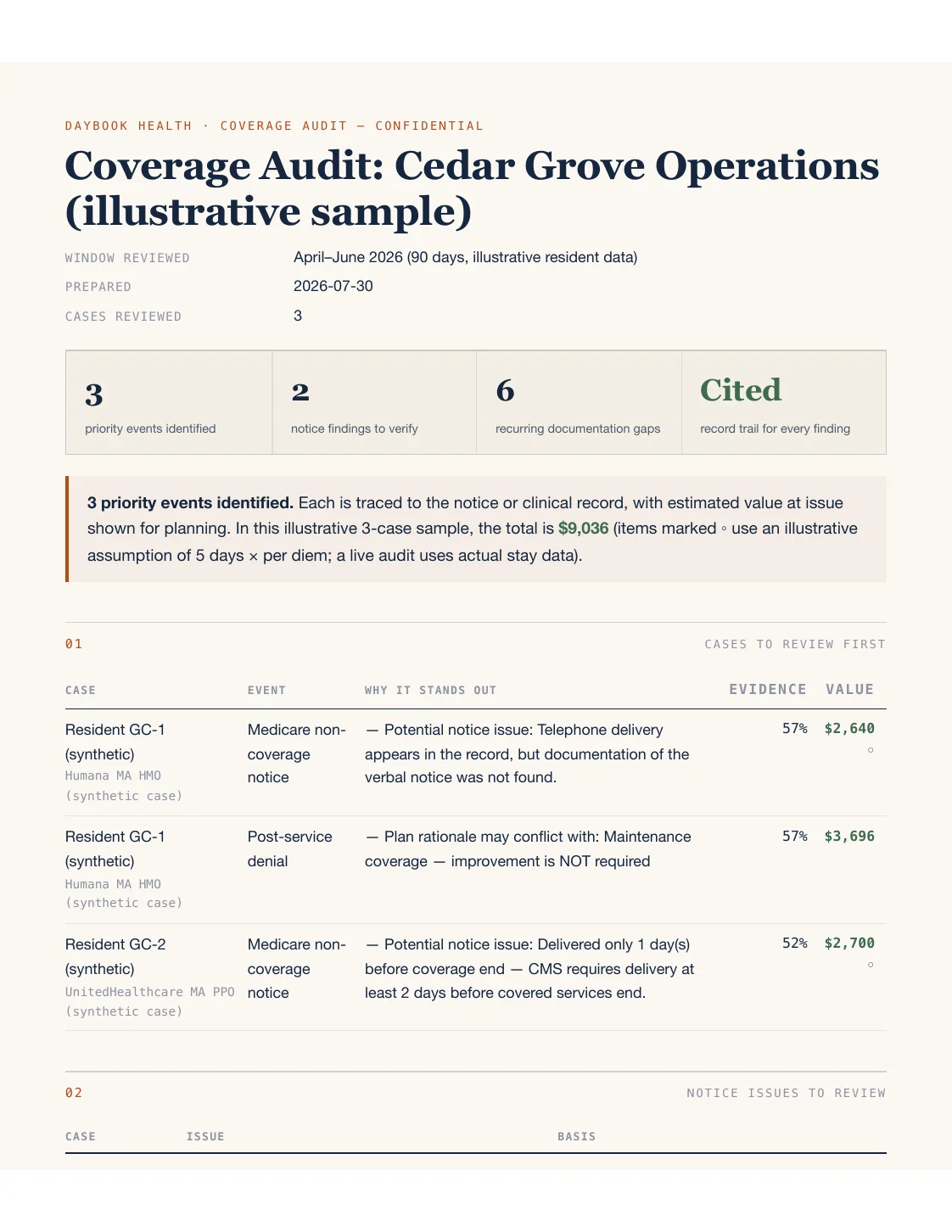
Review the same format your team receives: a prioritized coverage review for leadership and a cited evidence packet for case-level review. The examples use illustrative resident data.
Illustrative sample A ranked view of coverage events, estimated value at issue, notice problems, evidence on file, and recurring gaps across your facilities.
Open the sample review PDF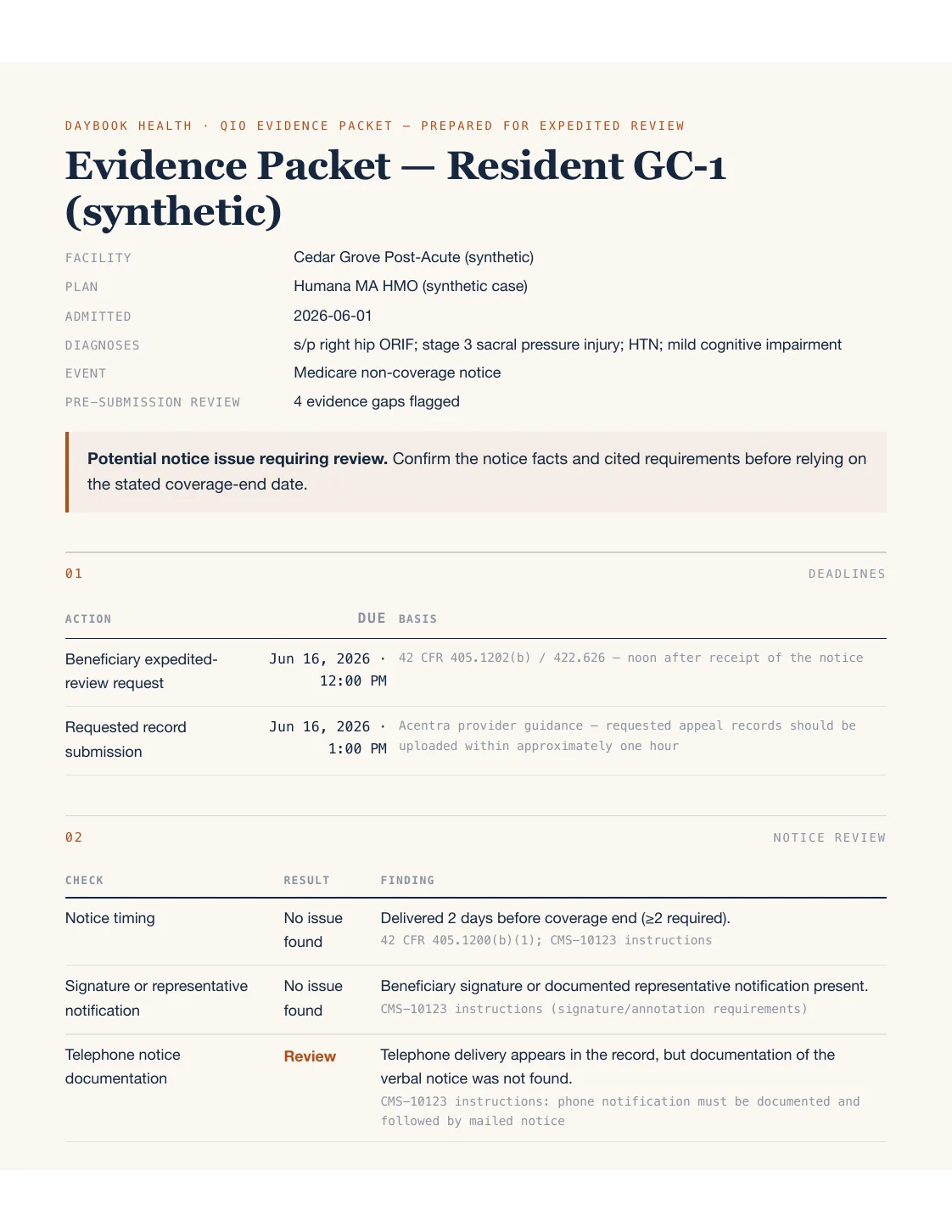 Illustrative sample
 The relevant deadline, notice findings, dated clinical timeline, skilled-need evidence, missing information, and a concise reviewer brief.
Open the sample packet PDFDaybook does the review and packet preparation. Your team does not need to implement a new system or add another queue to manage.
A one-page profile from public CMS data: county Medicare Advantage penetration against the national median, star ratings, and which QIO covers your states. Delivered within a day.
NOMNCs, denial letters, outcomes, and the supporting records for affected stays. BAA or de-identified. No integration, and no patient information through this site or ordinary email.
Daybook reviews the cases, checks the supporting record, prepares sample packets, and returns each finding with the evidence your team can inspect.
A fixed-fee pilot monitors new notices, prepares the evidence, keeps deadlines visible, and tracks outcomes across participating facilities — with the success measure agreed before the price.
Before your team acts, it can see what supports the finding, what is missing, which deadline applies, and who reviewed the packet.
Read the security and review practicesEach clinical finding includes the exact quote, document, and page.
A named person reviews each packet before your team receives it.
Every due date shows the notice date, applicable rule, and basis.
Beneficiary review rights and provider payment appeals stay distinct.
Start with the profile if you want to see the numbers first. Start with the review if you are ready to look at the record. If the review finds recoverable or protectable value, you will see exactly where it is. If it finds nothing, you will know your current process held up.
 Daniel Voigt · Founder
 Daniel Voigt is a former healthcare CTO who built and led an enterprise EHR and revenue-cycle platform through its acquisition. His work spanned claims and remittance processing, reimbursement, and the financial reporting healthcare CFOs rely on. Daybook applies that experience to the Medicare Advantage coverage work skilled nursing teams are asked to manage under pressure.
Why Daybook existsNo. Keep it. Those tools help get the stay authorized and the clinicals submitted. Daybook’s work starts when the plan moves to end coverage anyway: the notice, the record, the deadline, and the outcome.
A one-page summary of your facilities built from public CMS data: county Medicare Advantage penetration against the national median, star ratings, and which BFCC-QIO covers your states. Nothing to sign and no records involved. It is the easiest way to see whether a review is worth your time.
No. We start with the exports and documents your systems already produce. If you continue after the review, secure scheduled exports are enough to begin.
A ranked review of recent Medicare Advantage coverage events: which cases deserve attention, why they stand out, the estimated value at issue, notice problems, recurring documentation gaps, and sample evidence packets for the strongest cases.
The beneficiary or their authorized representative. Daybook prepares the facility-controlled evidence, validity findings, deadline summary, and cited packet. Provider payment appeals remain a separate lane. Nothing is filed on anyone’s behalf without proper authorization.
Not through this website and never by ordinary email. Identifiable files are accepted only after the engagement’s BAA is in place and through an access-controlled upload channel. De-identified samples are welcome for the first conversation.
No. Daybook organizes the record and prepares the work for review. Your team can see the exact quote, document, and page behind every clinical finding, and a named person reviews each packet before it is used.
The profile and the review are free. If the review shows a worthwhile opportunity, the next step is a fixed-fee pilot over a defined group of facilities — a flat price agreed up front, with the success measure agreed before the price, and never a percentage of what is recovered. Ongoing pricing is a per-facility subscription sized against the value your own review demonstrates.
Acentra Health BFCC-QIO, Annual Medical Review Services Report CY2025: 241,750 MA post-acute termination appeals reviewed; physician reviewers disagreed with the plan in 56.47% of cases. Primary report ↗
Acentra Health BFCC-QIO, CMS-approved focused study on Notices of Medicare Non-Coverage in post-acute care. Study summary ↗
BFCC-QIO expedited-review operating procedures. Acentra operationally asks facilities to upload requested records on an approximately one-hour clock. Acentra webinar Q&A ↗
HHS OIG OEI-09-24-00331 (June 2026). The widely reported 95% figure concerns appealed skilled-nursing-facility admission prior-authorization denials, not continued-stay terminations. HHS OIG report ↗
42 CFR 422.626, fast-track appeals of service terminations. Paragraph (c) places the burden of proof on the MA organization; paragraph (e)(3) sets the plan’s deadline to supply the reviewer with the information supporting its decision. Regulation text ↗
LeadingAge, on the prior-authorization changes announced by UnitedHealthcare and Optum effective October 1, 2026: not applicable to skilled nursing facilities or home health agencies. LeadingAge summary ↗